
10–25 barg
Blowing pressure at nozzle
Boiler · On-load heating-surface cleaning
A soot blower removes ash and slag from boiler heating surfaces with steam or air jets while the unit stays on load. Keeping surfaces clean holds heat transfer at design: every 20 °C of fouling-driven stack-temperature rise costs about one percentage point of boiler efficiency. On bagasse units, blowers at 10–25 barg typically cycle every 8–24 h.
01 — Why it matters
Deposits are an insulating layer on every heating surface — and the stack thermometer reports the bill.
Every deposit layer on a boiler heating surface is thermal insulation in exactly the wrong place. Ash on superheater, generating-bank, economizer and air-preheater surfaces raises the resistance between hot gas and working fluid, so less heat transfers per pass and the gas leaves the boiler hotter. The penalty follows a simple rule used throughout this site: every ~20 °C of stack-temperature rise costs about one percentage point of boiler efficiency. A bagasse boiler drifting 40 °C above its clean-condition stack temperature between maintenance outages is burning roughly two percentage points of fuel to heat the sky — on a fuel of ~50 % moisture and LHV 7.2–7.5 MJ/kg, where every point of efficiency is already hard-won.
Soot blowers exist to interrupt that drift on load. A soot blower is a fixed or retractable lance that projects steam or compressed-air jets onto heating surfaces on a programmed sequence, removing deposits before they sinter into layers that only an outage and manual lancing can shift. The system is part of Arrow Energy's boiler pressure parts and heat-recovery line, and it is inseparable from the surfaces it protects: a economizer or air preheater retrofit that recovers 3.1–4.0 percentage points of efficiency keeps that recovery only if its surfaces stay clean. Sizing, placement and sequencing are engineered from the fuel's fouling behaviour — bagasse and rice husk carry high char and abrasive high-silica ash, which forgives nothing done casually.
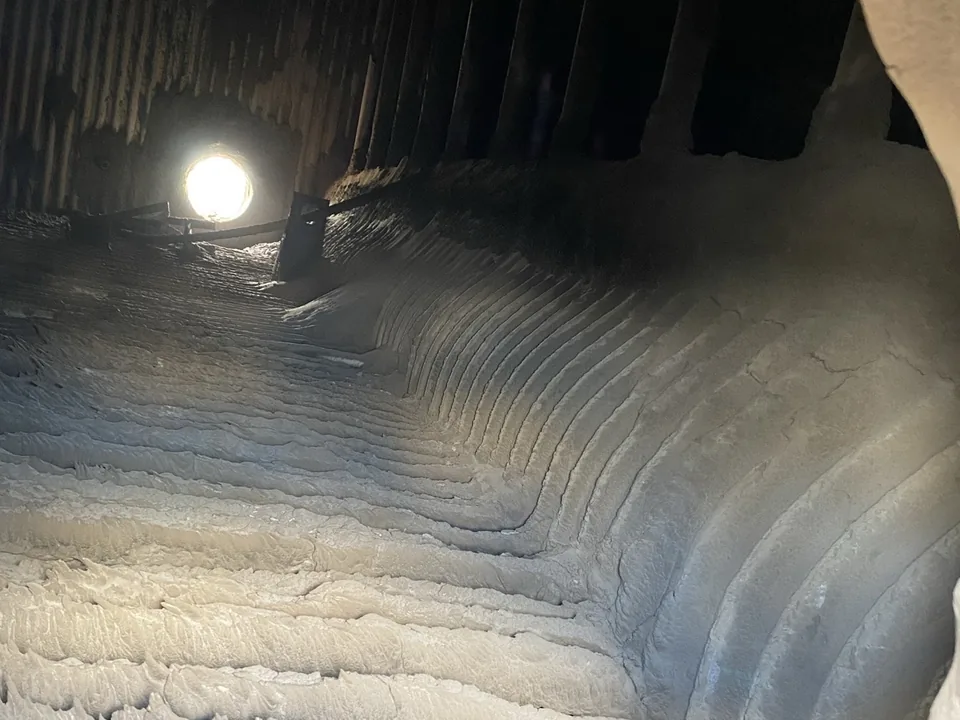
Before — no soot blower installed
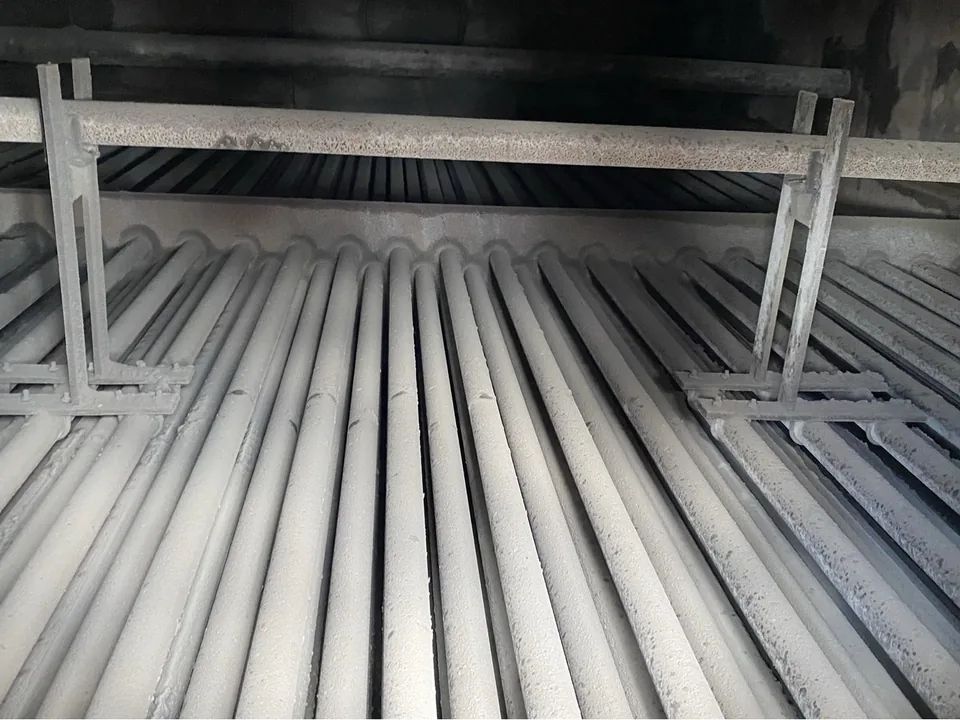
After — Arrow soot blower in service
02 — Blower types
The gas temperature at the surface decides which hardware survives there.
Three families cover practical boiler cleaning. Long-retractable blowers carry a lance with opposed nozzles that advances into the gas pass while rotating, cleaning a helical path, then withdraws completely — the only type that survives in superheater-zone gas, because the lance is out of the flow except during the blow. Short-retractable wall blowers insert a short nozzle just proud of the furnace wall to clean a circular patch of water-wall tube. Rotary fixed blowers leave a multi-nozzle element permanently in the gas pass and rotate it during the blow — simple and cheap, but the element itself sits in the gas and ash flow, so they belong only in cooler zones. Acoustic horns clean with low-frequency sound that keeps friable ash from consolidating; they touch nothing and erode nothing, but move no sintered deposit.
| Parameter | Long retractable | Wall blower (short retract) | Rotary fixed | Acoustic horn |
|---|---|---|---|---|
| Cleaning medium | Steam or air jet | Steam or air jet | Steam or air jet | Sound, 60–250 Hz typ. |
| Coverage per unit | Full lance travel across the pass, helical path | Circular wall patch around the nozzle | Fixed radius around element | Volume-filling, line-of-sight independent |
| Tube-erosion risk | Moderate — controlled by pressure and lane alignment | Moderate — wall-tube thinning at the swept patch | Higher — repeated blows on the same nearby tubes | None |
| Steam per cycle | CONFIRM: kg/cycle per blower model and lance length | CONFIRM: kg/cycle per blower model | CONFIRM: kg/cycle per blower model | 0 kg — compressed air, minor |
| Suitable zones | Superheater, generating bank, hot economizer | Furnace water walls | Economizer, air preheater, cooler banks | Economizer, air preheater, hoppers, bag-filter casings |
| Deposit types handled | Slag, sintered and friable ash | Wall slag, refractory-zone deposits | Friable and lightly bonded ash | Dry friable ash only |
Steam consumption per cycle is a real operating cost and a real design input for the PRDS and drains system; it varies with lance length, nozzle count and blowing pressure, so we state it per blower model in the project datasheet rather than quote a generic figure here.
03 — Medium and pressure
Cleaning power against tube erosion — and why wet steam is the fastest way to cut a tube.
Set 10–25 barg at the nozzle, supplied through a pressure-reducing and desuperheating station from a main-steam or extraction tapping. Within that band, use the lowest pressure that removes the deposit: peak impact pressure on the tube rises with supply pressure, and so does erosion of tube metal wherever the jet dwells.
The erosion mechanism is worth stating plainly. A steam jet that removes ash also removes the protective oxide layer from tube steel; blow the same spot too hard or too often and the tube wall thins measurably between inspections — on bagasse and rice-husk units the entrained abrasive silica ash sharpens the effect. The defence is procedural, not heroic: pressure set per zone against actual deposit strength, lance lanes aligned so jets pass between tubes rather than onto them, blowing arcs programmed to skip bare tube, and wall-thickness mapping at the swept patches during outages so the trend is known before it is a leak.
The second killer is condensate. Steam that arrives at the nozzle wet carries water slugs that strike tubes like shot — a condensate slug does more damage in one blow than weeks of correct blowing. This is why the supply comes from a PRDS engineered for the duty: pressure reduced to the 10–25 barg blowing band while retaining enough residual superheat that the steam stays dry through the piping run, plus automatic warm-up and drain sequencing that proves the line free of condensate before the poppet valve opens on each blower. Thermal drains, a sloped header layout and drain-temperature interlocks are part of the soot-blowing system, not accessories to it.
Steam or compressed air? Steam wins on most biomass units: it is drawn from the cycle at low marginal cost, delivers high mass flow per nozzle, and the PRDS infrastructure is modest. Compressed air removes the water-hammer risk entirely and takes nothing from steam generation — attractive where process steam is the plant's product — but the compressor power per cleaning cycle generally exceeds the equivalent steam cost, and receiver capacity must be sized for the blowing sequence, not the average demand.
04 — Sequencing
Blow on evidence of fouling, not on the clock — the instruments already exist.
Typical bagasse practice is a full sequence every 8–24 hours, tightened during high-fouling episodes such as wet-fuel operation or high mud content in the cane. A fixed timer is the crudest answer: it wastes blowing steam when surfaces are clean and lets deposits sinter when fouling accelerates. Condition triggers do better on both counts.
Three measurements make useful triggers. Furnace-exit gas temperature rises as furnace-wall deposits cut radiant absorption, and is the natural trigger for wall blowers: blow when FEGT crosses a band above its clean baseline, and superheater metal temperatures are protected as a side effect. Gas-side pressure drop across each convective bank rises as deposits close the gas lanes, and triggers the long-retractable and rotary blowers for that bank specifically — cleaning the bank that is dirty instead of the whole boiler. Heat-flux or duty calculation per bank, computed in the DCS from existing water/steam-side temperatures and flows, is the most direct: blow when the bank's absorbed duty falls a set percentage below its clean reference at that load.
Selective, triggered blowing typically cuts blowing-steam consumption meaningfully against a fixed full-sequence timer while holding a lower average stack temperature — both terms of the fouling equation move the right way. It also reduces erosion, because the surfaces that stay clean stop being blown. The control logic is not exotic; most of it can be configured in an existing DCS during a normal outage, and it is a standard recommendation in our boiler energy audit findings.
05 — Placement
A zone-by-zone map from furnace walls to air preheater.
| Zone | Deposit character | Blower type | Placement notes |
|---|---|---|---|
| Furnace water walls | Slagging, can vitrify | Wall blowers (short retract) | Arrayed on burner/grate-zone walls; FEGT-triggered |
| Superheater / hottest convective pass | Sintered ash bridging tube lanes | Long retractable | Lances between tube banks; lane alignment against erosion; first priority for coverage |
| Generating bank | Moderately bonded ash | Long retractable / rotary in cooler rows | ΔP-triggered per bank |
| Economizer | Friable ash, fin bridging | Rotary fixed or acoustic horns | Protects retrofit efficiency gain; gentle settings on finned tube |
| Air preheater | Fine ash, acid-dewpoint sticky layers at cold end | Rotary fixed or acoustic horns | Cold-end corrosion products need washing capability at outage |
| Hoppers / casings | Loose dust accumulation | Acoustic horns | Prevents bridging and rat-holing; no erosion concern |
The map is a starting grid, not a rule: an actual layout is drawn from the boiler's tube-bank geometry, measured fouling history and access for lance withdrawal — a long-retractable blower needs its full lance length clear outside the casing, which on tight biomass plants often decides between one long blower and two half-travel units on opposite walls.
06 — Payback
The efficiency arithmetic is short, and the audit measures every term.
Read the stack temperature trend between outages. If it climbs 30–40 °C from clean condition before each cleaning outage, the unit is averaging roughly 1–2 percentage points below its achievable efficiency — recoverable by adequate blower coverage and condition-triggered sequencing. The blowing-steam cost is real but small against fuel saved at that scale.
The full accounting has four terms: fuel saved from lower average stack temperature; blowing steam (or compressor power) consumed; tube-erosion and maintenance cost of the blowing itself; and availability — a boiler that fouls until it must come offline for manual cleaning loses generation days that dwarf the other terms. On sugar-mill units the seasonal pattern sharpens the case: the crushing season is short, every on-crop day matters, and a fouling-forced stop is paid in lost production, not just lost efficiency.
An Arrow Energy energy audit establishes the baseline with instruments rather than assumptions: stack temperature against load and cleanliness state, per-bank duty from existing DCS data, blowing-steam consumption per sequence, and tube-wall thickness at swept zones. The same audit separates fouling losses from excess-air losses — on biomass units running high excess air, trimming toward λ ≈ 1.15 is worth a further 0.7–0.8 percentage points and costs almost nothing — so the upgrade budget goes where the recoverable points actually are, across soot blowing, economizer surface and air-preheater condition together.
FAQ
A soot blower directs steam or compressed-air jets at boiler heating surfaces to remove ash and slag deposits while the unit stays on load. Keeping surfaces clean holds stack temperature at design; every 20 °C of fouling-driven stack-temperature rise costs roughly one percentage point of boiler efficiency.
Typical bagasse practice is a full sequence every 8–24 hours, but a fixed timer either wastes steam or lets fouling run. Better triggers are furnace-exit gas temperature, gas-side pressure drop across each bank, or heat-flux instruments, which start the sequence only when deposits are actually costing heat transfer.
Blowing pressure at the nozzle is typically set at 10–25 barg through a pressure-reducing and desuperheating station, with enough residual superheat that no condensate reaches the nozzle. Higher pressure cleans faster but erodes tubes; the setting is tuned per zone against deposit strength and measured tube-wall loss.
Steam is the usual medium on biomass boilers because it is drawn from the cycle at low marginal cost and delivers high mass flow per nozzle. Compressed air avoids taking steam from generation and suits plants with spare compressor capacity, but the electrical cost per cleaning cycle is generally higher.
Only for light, friable ash in low-temperature zones such as economizers, air preheaters and hopper walls. Acoustic horns cause no tube erosion and consume no steam, but they cannot remove sintered or slagged deposits in furnace and superheater zones, where retractable steam blowers remain necessary.
Fuel, boiler capacity, gas flow, current emission and the limit you must meet. An Arrow engineer replies with a technical assessment basis — not a brochure.